Front propagation

Verification of frontPropagation against closed-form solutions. All results
are from FEAScript-core 0.4.0, solved with lusolve.
Planar front
A front starts at one boundary, with zero gradient on the others. The exact solution of the eikonal equation is the distance to that boundary: in 1D on , and in 2D on a 4 m × 2 m domain.

Boundary layer at the outflow boundary
The model adds a viscous term that stabilizes the eikonal equation, with for an element of size . At the outflow boundary, opposite the front, the zero-gradient condition becomes , while the exact solution has . The solution bends to meet the condition in a boundary layer about wide. In 1D,
so in 1D the largest deviation, at the outflow boundary node, equals . Because of the floor on , it does not drop below under mesh refinement. Away from the outflow boundary the layer has decayed and the solution matches the exact one closely.
Results
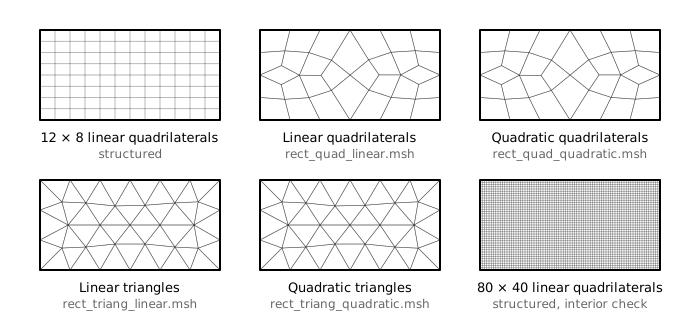
The largest deviation over all nodes is in the boundary layer. The table gives of the elements along the outflow boundary, which varies from element to element on the Gmsh meshes:
| Dimension | Elements | Mesh | at the outflow boundary | Largest deviation | Tolerance |
|---|---|---|---|---|---|
| 1D | Linear | 20 elements | 1.0e-2 | 1.0e-2 | 5e-2 |
| 1D | Quadratic | 20 elements | 1.0e-2 | 1.0e-2 | 5e-2 |
| 2D | Linear quadrilaterals | 12 × 8 structured | 2.9e-2 | 2.8e-2 | 5e-2 |
| 2D | Linear quadrilaterals | Gmsh, rect_quad_linear.msh | 5.4e-2 to 6.4e-2 | 7.1e-2 | 1.5e-1 |
| 2D | Quadratic quadrilaterals | Gmsh, rect_quad_quadratic.msh | 2.5e-2 to 3.0e-2 | 2.7e-2 | 5e-2 |
| 2D | Linear triangles | Gmsh, rect_triang_linear.msh | 3.6e-2 to 4.4e-2 | 4.4e-2 | 5e-2 |
| 2D | Quadratic triangles | Gmsh, rect_triang_quadratic.msh | 1.8e-2 to 2.2e-2 | 2.3e-2 | 5e-2 |
In 1D the largest deviation equals . In 2D it is close to along the outflow boundary. On the coarse Gmsh linear quadrilaterals it is about 10 % larger: the elements, about 0.6 wide, are too coarse to resolve a layer about 0.06 wide.
The interior, more than 0.5 (50 ) from the outflow boundary, is checked on meshes that resolve the layer:
| Dimension | Elements | Mesh | Region | Largest deviation | Tolerance |
|---|---|---|---|---|---|
| 1D | Linear | 80 elements | 2.4e-10 | 1e-8 | |
| 1D | Quadratic | 40 elements | 2.4e-10 | 1e-8 | |
| 2D | Linear quadrilaterals | 80 × 40 structured | 2.1e-6 | 1e-5 |
On coarser meshes the layer is not resolved and reaches further into the domain: in 1D the interior deviation is 8.8e-4 with 20 linear elements, 9.0e-7 with 40 and 2.4e-10 with 80.
In 1D the test also starts the front at , where the exact solution is ; the largest
deviation is again 1.0e-2. In every case the frontal solver matches lusolve to within 6.7e-16 (tolerance
1e-8).
Tests:
frontPropagation1DPlanarFront
and
frontPropagation2DPlanarFront.