Heat conduction

Verification of heatConduction against published benchmarks and closed-form
solutions. All results are from FEAScript-core 0.4.0, solved with lusolve.
The benchmark tests run on one mesh each. The convergence studies below were run for these pages with the same setups on a sequence of structured meshes, refined by a factor of 2 each time.
NAFEMS T4
A 0.6 m × 1.0 m plate, W/(m·K), with a fixed temperature of 100 °C on the bottom edge, an insulated left edge, and convection ( W/(m²·K), °C) on the top and right edges. The target is the temperature at point E (0.6 m, 0.2 m): 18.3 °C in the NAFEMS standard benchmarks (TNSB Rev. 3, 1990), the value used by most codes. COMSOL quotes 18.25 °C, citing the 1986 NAFEMS summary of the thermal benchmarks (Cameron, Casey and Simpson).


| Mesh | Linear (°C) | Quadratic (°C) |
|---|---|---|
| 3 × 5 | 8.4996 | 21.5227 |
| 6 × 10 | 17.9540 | 18.3984 |
| 12 × 20 | 18.0927 | 18.2558 |
| 24 × 40 | 18.2137 | 18.2539 |
| 48 × 80 | 18.2438 | 18.2538 |
Both element orders converge to 18.254 °C, which agrees with 18.25 °C and rounds to 18.3 °C. The plot shows the error against the finest quadratic result (18.2538 °C). Linear elements converge at second order on the finer meshes, quadratic elements at fourth order or faster.

The test checks the 12 × 20 quadratic mesh against 18.3 °C with a tolerance of 0.1 °C:
heatConduction2DNafemsT4.
This is an independent reproduction of the T4 problem and is not sponsored, endorsed, or affiliated with NAFEMS.
Code_Aster TPLP302
From the Code_Aster validation manual (V4.05.302): a strip 0.2 m wide and 2 m long, , with 100 °C on the bottom edge, 0 °C on both side edges and an insulated top edge. The strip is ten widths long, so the solution is that of a semi-infinite strip (Welty, Wicks and Wilson):
with °C and m. The temperature jumps from 100 °C to 0 °C at the two bottom corners.


| Point | x (m) | y (m) | Reference (°C) | Quadratic 8 × 80 (°C) | Quadratic 16 × 160 (°C) |
|---|---|---|---|---|---|
| E | 0.05 | 0.05 | 43.496 | 43.483 | 43.495 |
| F | 0.05 | 0.10 | 18.978 | 18.977 | 18.978 |
| G | 0.05 | 0.15 | 8.559 | 8.558 | 8.559 |
| H | 0.10 | 0.05 | 54.467 | 54.470 | 54.467 |
| I | 0.10 | 0.10 | 26.096 | 26.096 | 26.096 |
| J | 0.10 | 0.15 | 12.032 | 12.032 | 12.032 |
| K | 0.10 | 0.20 | 5.499 | 5.499 | 5.499 |
The convergence study measures the largest error at the seven points against the series:
| Mesh | Nodes (linear) | Error, linear (°C) | Order | Nodes (quadratic) | Error, quadratic (°C) | Order |
|---|---|---|---|---|---|---|
| 4 × 40 | 205 | 6.9e0 | 729 | 6.4e-1 | ||
| 8 × 80 | 729 | 1.6e0 | 2.08 | 2,737 | 1.3e-2 | 5.64 |
| 16 × 160 | 2,737 | 3.5e-1 | 2.21 | 10,593 | 1.6e-4 | 6.28 |
| 32 × 320 | 10,593 | 8.5e-2 | 2.04 | 41,665 | 9.9e-6 | 4.04 |
Linear elements converge at second order. Quadratic elements converge at fourth order or faster at these points: nodal values of quadratic elements often converge faster than the solution between the nodes.

The test checks the 8 × 80 quadratic mesh against the reference values (relative tolerance 1e-3) and the
16 × 160 quadratic mesh against the series (tolerance 2e-3 °C):
heatConduction2DCodeAsterTplp302.
This is an independent reproduction and is not sponsored, endorsed, or affiliated with EDF or the Code_Aster
project.
Code_Aster TPLP01
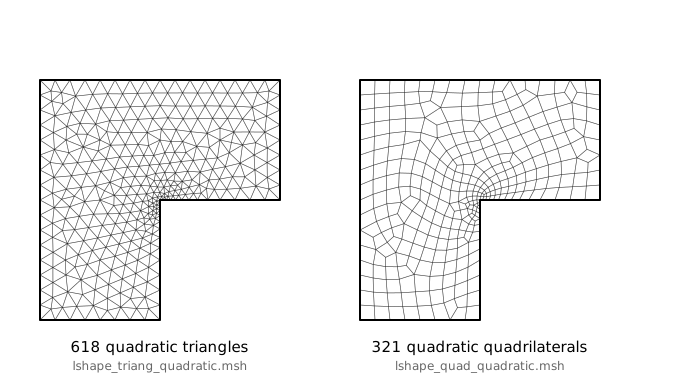
From the Code_Aster validation manual (V4.05.001), which takes the problem and its reference values from the VPCS validation guide (SFM/AFNOR, 1990, after Symm, NPL Report NAC 31, 1973). An L-shaped domain, a 0.8 m × 0.8 m square without its 0.4 m × 0.4 m bottom right quarter, , with 10 °C on the left edge, 0 °C on the right edge (, ) and all other edges insulated. The temperature gradient is singular at the re-entrant corner (0.4, 0.4).

The meshes are made with Gmsh, with an element size of 0.05 m refined to 0.01 m at the corner: 618 six-node triangles and 321 nine-node quadrilaterals, both with a node at each reference point.
| x (m) | y (m) | Reference (°C) | Triangles (°C) | Quadrilaterals (°C) |
|---|---|---|---|---|
| 0.2 | 0.0 | 9.316 | 9.307 | 9.307 |
| 0.2 | 0.2 | 9.001 ¹ | 9.100 | 9.101 |
| 0.2 | 0.4 | 8.514 | 8.516 | 8.517 |
| 0.2 | 0.6 | 8.018 | 8.018 | 8.018 |
| 0.2 | 0.8 | 7.869 | 7.874 | 7.874 |
| 0.4 | 0.0 | 9.009 | 9.008 | 9.008 |
| 0.4 | 0.2 | 8.640 | 8.660 | 8.660 |
| 0.4 | 0.4 | 6.667 | 6.666 | 6.665 |
| 0.4 | 0.6 | 5.680 | 5.670 | 5.670 |
| 0.4 | 0.8 | 5.495 | 5.496 | 5.496 |
| 0.6 | 0.4 | 2.972 | 2.967 | 2.967 |
| 0.6 | 0.6 | 2.881 | 2.881 | 2.881 |
| 0.6 | 0.8 | 2.816 | 2.819 | 2.819 |
Triangles and quadrilaterals agree within 0.001 °C, and the values hardly change on a mesh of about 20,000 nodes. The largest deviation from the reference is 0.24 %, apart from the point marked ¹.
¹ At (0.2, 0.2) the published 9.001 °C is 1.1 % below the FEAScript result, which is mesh-converged (9.1007 °C on the 20,000-node mesh). It is likely a misprint of about 9.10 °C.
The test checks every point on both meshes with a relative tolerance of 5e-3 (1.5e-2 at the point
marked ¹):
heatConduction2DCodeAsterTplp01.
This is an independent reproduction and is not sponsored, endorsed, or affiliated with EDF, the Code_Aster
project, SFM or AFNOR.
Spatially varying coefficients
Closed-form solutions with spatially varying and , chosen so that the finite element solution is exact at
the nodes. Every nodal value must match to within 1e-10; the observed deviations are of order 1e-15.

| Dimension | Exact solution | Elements | ||
|---|---|---|---|---|
| 1D | 1 | 1 | Linear | |
| 1D | −1 | Linear, quadratic | ||
| 2D | −1 | Quadratic quads | ||
| 2D | −1 | Quadratic quads |
The 1D test also checks the frontal solver against lusolve. Tests:
heatConduction1DVaryingCoefficients
and
heatConduction2DVaryingCoefficients.